Discover the Grand Egyptian Museum
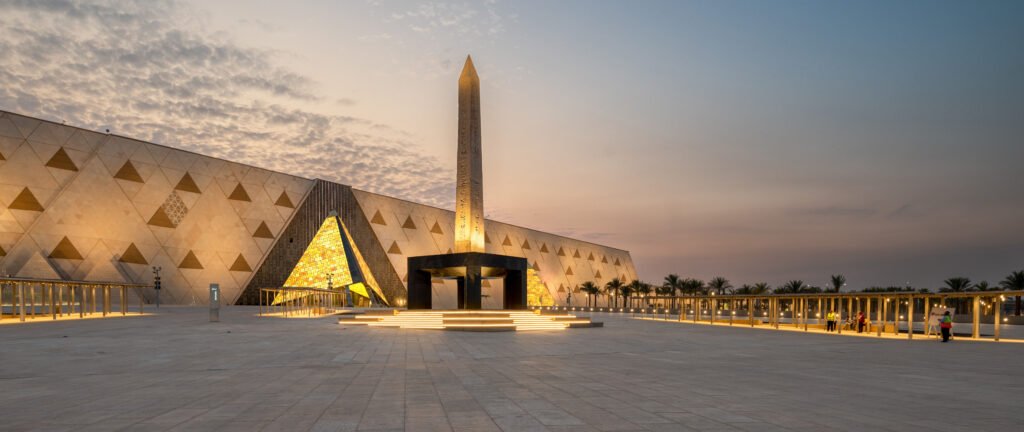
The largest and first in the world
The Grand Egyptian Museum is distinguished by being the largest museum in the world in terms of area, which is 500,000 square meters and is located one mile from the Giza Pyramids, and the first museum in the world to contain 100,000 artifacts of one civilization, including the collections of King Tutankhamun.
The Grand Egyptian Museum (GEM) is one of Egypt’s most important cultural landmarks and a spectacular destination for anyone interested in Ancient Egyptian history, archaeology, art and architecture.
Located near the Giza Pyramids, the museum brings together an extraordinary collection of ancient Egyptian artefacts spanning thousands of years, from prehistoric Egypt through the Roman Period. Its collections explore the lives, beliefs, kingship and achievements of one of the world’s greatest civilizations.
Among its highlights are the Tutankhamun Galleries, Grand Hall, Grand Stairs, Hanging Obelisk, Main Galleries and Khufu’s Boats Museum.
Why Visit the Grand Egyptian Museum?
A visit to the Grand Egyptian Museum offers the opportunity to experience Ancient Egypt in a modern museum environment.
Visitors can:
- Explore thousands of years of Egyptian history.
- Discover artefacts from the prehistoric period to the Roman era.
- Visit the galleries dedicated to King Tutankhamun.
- See monumental statues and architectural elements.
- Walk beneath the Hanging Obelisk.
- Explore the Grand Hall and Grand Stairs.
- Discover the ancient boats associated with King Khufu.
- Experience interactive and technology-based educational programmes.
- Enjoy restaurants, cafés, gardens and retail outlets.
- Take part in guided tours and special experiences.
- Explore conservation and research work associated with Egypt’s archaeological heritage.
GEM Complex
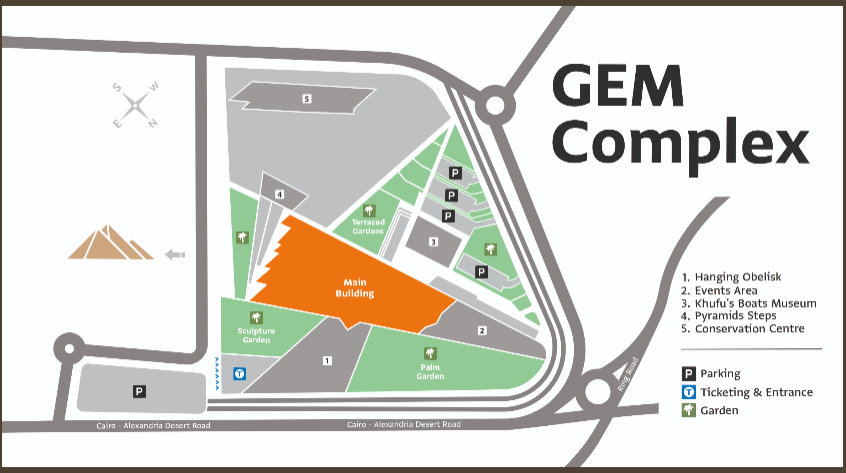
The Grand Egyptian Museum is more than a collection of exhibition galleries. It is a large cultural and visitor complex.
The entire GEM complex covers approximately 500,000 square metres.
The main building is divided into:
- Museum section: approximately 92,000 square metres.
- Commercial section: approximately 40,000 square metres.
Visitors enter through the Grand Hall, where the monumental statue of King Ramesses II creates one of the museum’s most dramatic first impressions
Main Attractions at the Grand Egyptian Museum
1. Hanging Obelisk
The Hanging Obelisk is one of the most distinctive architectural features at GEM.
It stands in a large 30,000-square-metre piazza in front of the museum’s main entrance and was designed to allow visitors to see the inscriptions on the underside of the monument.
The obelisk belongs to King Ramesses II and was originally erected at Tanis in the Eastern Delta.
The granite monument is approximately 16 metres high and weighs about 87 tonnes. It is supported above the ground by a modern structural system, creating a remarkable combination of ancient Egyptian archaeology and contemporary engineering.
2. Grand Hall
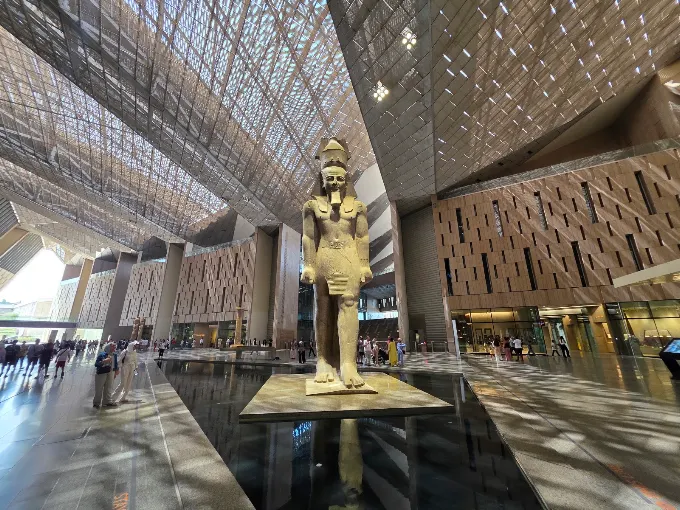
The Grand Hall welcomes visitors into the museum.
It features monumental ancient Egyptian statues and architectural elements, allowing visitors to encounter some of the civilization’s most impressive representations of kings and rulers.
Among the important objects displayed in this area is the colossal statue of King Ramesses II, originally associated with the temple of the god Ptah at Memphis.
The statue is approximately 11.35 metres high and is one of the most recognizable monumental objects at GEM.
3. Grand Stairs
The Grand Stairs form one of the museum’s major exhibition experiences.
They present monumental statues and architectural elements associated with Egyptian kingship, religion and funerary traditions.
The experience is organized around themes including:
- Royal Images
- Divine Houses
- Gods and Kings
- Journey to Eternity
The Grand Stairs include important monuments representing rulers such as Ramesses II, Hatshepsut, Thutmose III and Senwosret I. GEM’s guided-tour information states that the Grand Stairs display 59 significant artefacts.
Main Galleries
Ancient Egyptian Society, Kingship and Beliefs
The Main Galleries present the story of ancient Egyptian civilization through three major themes:
Society
Discover the diversity of ancient Egyptian society through objects that reveal aspects of everyday life, culture and social organization.
Kingship
Explore the origins and development of kingship, the role of queens and the royal family, and the evolution of royal power from prehistoric times through the Roman Period.
Beliefs
Explore the religious ideas that shaped ancient Egyptian life, including concepts of gods, death, the afterlife and the relationship between people and the divine.
Together, the Main Galleries provide a chronological and thematic journey through Ancient Egyptian civilization.
Tutankhamun Galleries
Tutankhamun Galleries
The Tutankhamun Galleries are among the most anticipated highlights of the Grand Egyptian Museum.
The galleries bring together the treasures discovered in the tomb of the young pharaoh Tutankhamun, allowing visitors to explore the king’s life, identity, burial and beliefs in the afterlife.
GEM’s guided-tour information states that more than 5,000 artefacts from Tutankhamun’s tomb are presented together as part of the museum experience.
The Tutankhamun experience is organized around several themes:
Discovery
Learn about the discovery of Tutankhamun’s tomb in 1922 by Howard Carter and his team, with financial support from Lord Carnarvon.
Identity
Explore Tutankhamun’s family, identity and questions surrounding his life and death through archaeological and scientific evidence.
Funeral
Discover the coffins, shrines and funerary equipment designed to protect the king and support his journey into the afterlife.
Lifestyle
Explore objects that provide insights into Tutankhamun’s daily life and royal lifestyle.
The Golden Burial Mask of Tutankhamun
The solid-gold mask was placed over the head and shoulders of the king’s mummy. Its design combines an idealized royal portrait with religious symbolism associated with Osiris and the sun god Re.
The mask incorporates gold and other precious materials, including glass, lapis lazuli, obsidian, carnelian, faience and quartzite.
The museum identifies the mask with GEM number 8.
Tutankhamun’s Funerary Equipment
The Tutankhamun collection includes numerous objects associated with the king’s burial, including:
- Golden coffinettes
- Canopic equipment
- Funerary shrines
- Coffins
- Jewellery
- Furniture
- Chests
- Statues
- Ritual objects
- Personal and lifestyle items
Among these is the king’s canopic chest, which contained four miniature coffins designed to hold his mummified internal organs
Khufu’s Boats Museum
Ancient Boats from the Giza Pyramid Complex
The Khufu’s Boats Museum is dedicated to two ancient boats associated with King Khufu, the builder of the Great Pyramid at Giza.
Five boat pits were discovered in connection with Khufu’s funerary complex, including two sealed pits found in 1954 near the southern side of the Great Pyramid.
The first boat was reconstructed from dismantled wooden components and measures approximately 42.32 metres long.
The second boat has also undergone excavation, conservation and transportation to GEM. Visitors are intended to be able to observe aspects of its conservation and reconstruction as part of the museum experience.
The precise function of the boats remains debated. They are generally interpreted as vessels connected either with the king’s funeral or with his journey into the afterlife alongside the sun god Re.
GEM Collection
Treasures of Ancient Egypt
The GEM collection covers an extensive chronological range, from the Prehistoric Period through the Roman Period.
The collection includes:
- Statues
- Colossi
- Royal sculpture
- Funerary objects
- Jewellery
- Furniture
- Weapons
- Architectural elements
- Religious objects
- Boats
- Mummies and human remains
- Textiles
- Papyrus
- Pottery
- Glass
- Faience
- Wooden artefacts
- Stone monuments
The museum’s online collection allows visitors to explore individual artefacts and their archaeological information, including period, dynasty, provenance, material, dimensions and descriptions.
Featured Artefacts
Obelisk of King Ramesses II
A granite obelisk associated with Tanis, approximately 16 metres high and weighing about 87 tonnes.
Statue of Queen Hatshepsut
A monumental red-granite statue of Queen Hatshepsut, discovered at her mortuary temple at Deir el-Bahari in Luxor.
Colossal Osiride Statue of Senwosret I
A red-granite representation of King Senwosret I in Osiride form, discovered at Abydos.
Colossi from Thonis-Heracleion
The Grand Hall includes monumental objects recovered through underwater archaeological excavations at the sunken city of Thonis-Heracleion, including colossal representations of a Ptolemaic king and queen.
GEM Children’s Museum
The GEM Children’s Museum introduces younger visitors to Ancient Egyptian civilization through interactive and hands-on experiences.
Its educational themes include:
- Ancient Egyptian history
- The Nile and the land of Egypt
- Kingship and the state
- Ancient Egyptian communities
- Religious beliefs
- Knowledge and technology
- Archaeology and conservation
- Ancient crafts and construction
Children can explore subjects such as farming, the annual Nile flood, kings and queens, music, games, mummification, hieroglyphs, astronomy, engineering and archaeological excavation through interactive activities
Mixed-Reality Experience
Discover the Origins of the Pyramids
The experience explores ancient Egyptian ideas about death, burial and rebirth while presenting aspects of the engineering and construction of the pyramids through immersive technology.
Important visitor information:
- Available in English and Arabic.
- Duration: approximately 15 minutes.
- Visitors should arrive 10 minutes before their scheduled time.
- Each session accommodates up to 8 participants.
- Not suitable for children under six.
- Not recommended for people prone to motion sickness or dizziness or for visitors with certain medical conditions.
The experience can be booked as an additional on-site experience
Restaurants and Dining
The Grand Egyptian Museum includes a range of food and beverage options.
Current GEM listings include:
- 30 North
- Zooba
- Bitter Sweet Life
- Beano’s Café
- Ladurée
- Dolato
- Premium Mart
- Mandarine Koueider
- Starbucks
GEM also lists two fine-dining restaurants overlooking the Giza Pyramids as forthcoming experiences
Facilities at GEM
Visitors can find a wide range of facilities at the museum, including:
- ATMs
- Elevators
- Tour earphone desk
- Free lockers
- Medical clinic
- Accessible restrooms
- Prayer room
- Parking
- Mobile charging stations
- Lost and Found
- Information desk
- Gardens
- Educational facilities
- Conference facilities
- Restaurants and cafés
- Retail shops
- Wheelchairs
- Golf carts to assist with mobility
- Special elevators
- Seating areas
- Tactile replicas
- Braille-related accessibility features
GEM also provides free admission for eligible visitors with disabilities, subject to the museum’s current ticketing rules and identification requirements
Visiting the Grand Egyptian Museum
Opening Hours
According to the current GEM opening-hours information:
Sunday, Monday, Tuesday, Thursday and Friday
GEM Complex: 8:30 AM – 7:00 PM
Galleries: 9:00 AM – 6:00 PM
Last gallery entry: 5:00 PM
Wednesday and Saturday
GEM Complex: 8:30 AM – 10:00 PM
Galleries: 9:00 AM – 9:00 PM
Last gallery entry: 8:00 PM
GEM Children’s Museum
Sunday–Thursday: 1:00 PM – 5:00 PM
Friday–Saturday: 10:00 AM – 5:00 PM
Opening times may change during public holidays, special events or operational updates. Always check the official GEM website before travelling.
Grand Egyptian Museum Ticket Prices
The official GEM ticketing portal currently lists the following standard admission prices
Update Sep. 2026
| Visitor Category | Adult | Child | Student |
| Other Nationalities | EGP 1,500 | EGP 750 | EGP 750 |
Prices and ticket categories are subject to change. Visitors should verify the price for their chosen date through the official ticketing portal before booking.
Official Ticketing Website
GEM states that its official ticketing website is the authorized platform for purchasing museum tickets.
Photography and Filming
Personal photography and filming are generally permitted inside GEM, including with mobile phones and cameras, subject to museum restrictions.
Inside the Tutankhamun Galleries, photography rules are more restrictive, with mobile photography permitted according to the current visitor regulations.
Flash photography, tripods, selfie sticks, drones and live streaming are not permitted under the current ticketing-site visitor rules.
Commercial photography and filming require prior written permission.
Visitor Rules
To protect the museum’s collections and provide a comfortable experience, visitors are expected to:
- Respect museum staff and other visitors.
- Follow signs and staff instructions.
- Avoid touching objects unless participating in an authorized touch experience.
- Keep food and drinks out of the galleries.
- Wear appropriate clothing.
- Avoid disruptive or offensive behaviour.
- Avoid littering or damaging museum property.
- Smoke only in designated outdoor areas.
Getting to the Grand Egyptian Museum
The Grand Egyptian Museum is located at El Remayah Square along the Cairo–Alexandria Desert Road, close to the Giza Pyramids.
By Car
Visitors approaching from the Cairo area can use the Cairo–Alexandria Desert Road toward Remaya Square and follow the museum parking signs.
Scientific Research
GEM includes specialized scientific and research laboratories equipped with advanced technologies for examining archaeological materials.
The laboratories support:
- Archaeological research
- Conservation
- Material analysis
- Scientific investigation
- Preservation of cultural heritage
- Collaboration between archaeologists, scientists, engineers and specialists from other fields
The museum’s research infrastructure allows scientific investigation to contribute directly to the preservation and interpretation of archaeological objects.
Frequently Asked Questions
What is the Grand Egyptian Museum?
The Grand Egyptian Museum, commonly known as GEM, is a major archaeological museum near the Giza Pyramids in Egypt, dedicated primarily to the history and material culture of Ancient Egypt.
Where is the Grand Egyptian Museum located?
GEM is located at El Remayah Square along the Cairo–Alexandria Desert Road near the Giza Pyramids.
What can I see at the Grand Egyptian Museum?
Major attractions include the Main Galleries, Tutankhamun Galleries, Grand Hall, Grand Stairs, Hanging Obelisk and Khufu’s Boats Museum.
Does the Grand Egyptian Museum have Tutankhamun’s treasures?
Yes. The Tutankhamun Galleries are dedicated to the treasures of King Tutankhamun and include thousands of objects associated with his tomb and burial.
How long should I spend at the Grand Egyptian Museum?
The ideal visit length depends on your interests. Visitors who want to explore the Main Galleries, Tutankhamun Galleries and major architectural attractions should allow several hours rather than treating GEM as a short stop.
Can I take photos inside GEM?
Personal photography is generally permitted, subject to museum regulations and restrictions in certain areas.
Is the Grand Egyptian Museum suitable for children?
Yes. GEM includes a dedicated Children’s Museum and educational experiences designed to introduce younger visitors to Ancient Egyptian history and culture.
Is the Grand Egyptian Museum wheelchair accessible?
Yes. GEM provides accessibility services including wheelchairs, mobility assistance, special elevators, accessible restrooms and seating areas.
Can I buy souvenirs at the Grand Egyptian Museum?
Yes. GEM includes a museum shop and retail area offering books, jewellery, reproductions, artwork, handicrafts and other Egyptian-inspired products.
Can I buy tickets online?
Yes. Visitors can purchase tickets through the official GEM ticketing platform.
Is the Grand Egyptian Museum close to the Pyramids of Giza?
Yes. The museum is located near the Giza Pyramids and was specifically designed as a major cultural destination in the Giza archaeological landscape.
Final Travel Tip
The Grand Egyptian Museum is a large complex, so visitors should plan their time before arriving. Checking opening hours, ticket availability, entry times and any special experiences in advance can make the visit considerably easier.
For the most accurate ticket prices, opening hours and visitor regulations, always check the official Grand Egyptian Museum website before your trip.
1 thought on “Grand Egyptian Museum (GEM), Cairo.”